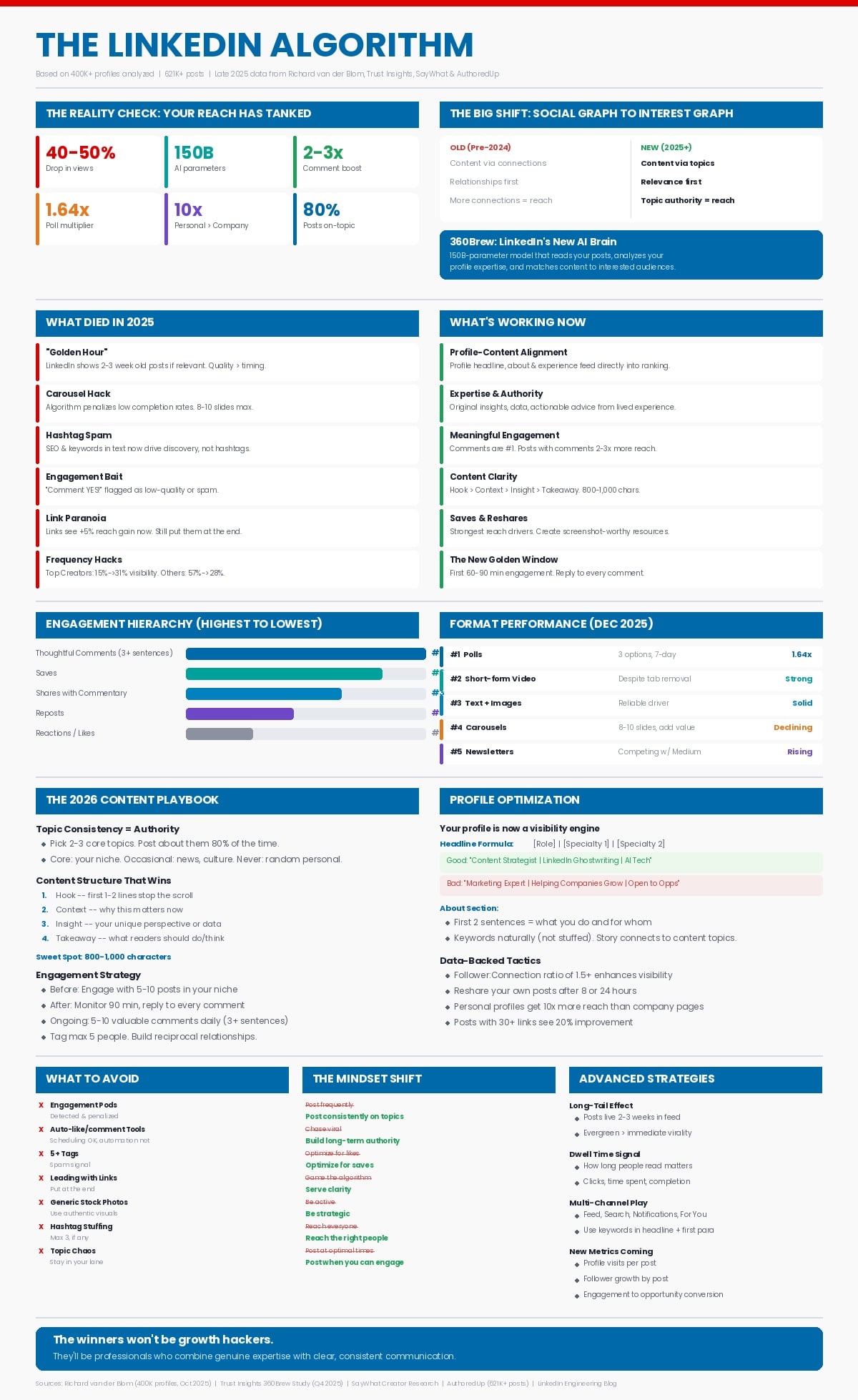
The 2026 LinkedIn Algorithm

Sachin Jha
CEO @ Ocean Labs
The LinkedIn Algorithm: 2026 Edition
What Actually Changed, What Died, and What Works Now
Based on the most recent late-2025 algorithm studies including Richard van der Blom’s analysis of 400,000 profiles, SayWhat Creator Research, Trust Insights 360Brew Study, plus verified data from LinkedIn Engineering Blog and independent research from AuthoredUp (621K+ posts)
The Reality Check: Your Reach Has Tanked
(And It’s Not Just You)
The Hard Numbers
According to recent algorithm analyses including Richard van der Blom’s research analyzing 400,000+ profiles and multiple independent studies:
- Views down significantly (reports show 40–50% drops)
- Engagement down
- Follower growth down
- Median impressions down dramatically since 2023
- Top-performing posts now vastly outperform average content
What happened? LinkedIn didn’t just tweak the algorithm — they rebuilt it from scratch.
The Big Shift: From Social Graph to Interest Graph
What Changed at the Core
Old System (Pre-2024)
- Social Graph: Content spread through who you know
- If your connections liked it → it showed up in feeds
- Relationships came first, relevance second
- Simple: more connections = more reach
New System (2025–2026)
- Interest Graph: Content spreads through what you talk about
- LinkedIn groups people by topics, not connections
- Relevance comes first, relationships second
- Complex: topic authority = reach
Meet 360Brew: LinkedIn’s New AI Brain
What It Is
- A 150 billion-parameter AI model
- Reads and understands your content like a human editor
- Replaces multiple old algorithms with one unified system
- Powers feed, search, job recommendations, and ads
What It Does
- Actually reads your posts (not just counts likes)
- Analyzes your profile to understand your expertise
- Matches content to interested audiences based on topics
- Learns from your last 2–3 months of activity to personalize
Current Status
- Quietly rolling out since mid-2024
- Estimated 40–100% deployed (LinkedIn hasn’t confirmed exact %)
- Even if only 40% deployed, that’s half your audience seeing ranked content this way
What Died in 2025
1. The “Golden Hour” Obsession
What it was: Post at 8am Tuesday, get engagement in first hour, win algorithm.
Reality now: LinkedIn confirmed in mid-2025 it now shows older posts (2–3 weeks old) if they’re more relevant to users’ professional interests.
What this means: Evergreen content has a long tail. Quality > timing.
2. The Carousel Hack
What it was: 10-slide carousels with generic advice = guaranteed reach.
Reality now: Documents now see lower engagement due to algorithm penalties for low completion rates, with best-performing documents having 8–10 slides and strong visual storytelling.
What this means: Carousels still work, but only if genuinely valuable.
3. Hashtag Spam
What it was: #Sales #Marketing #Leadership #Business #Growth
Reality now: LinkedIn shifted toward SEO and intent-based discovery, scanning words in post copy instead of using hashtags to enhance reach.
What this means: Keywords in your text > hashtags.
4. Engagement Bait
What it was: “Comment YES if you agree!” “Tag someone who needs this!”
Reality now: LinkedIn’s algorithm is getting better at detecting engagement bait and prioritizing meaningful conversations instead.
What this means: These posts now get flagged as low-quality or spam.
5. Link-Free Paranoia (Slightly Improved)
What it was: Never include links or reach dies.
Reality now: Posts with links see a modest 5% gain in reach, reversing a multi-year decline, with shorter value-first captions paired with links performing better.
What this means: Links still hurt, but less than before. Put them at the END.
6. Posting Frequency Hacks
What it was: Post 3x daily = 3x the reach.
Reality now: Since 2022, visibility of content from Top Creators rose from 15% to 31%, while visibility from Other Creators dropped from 57% to 28%.
What this means: Consistency matters, but topic authority matters more.
What’s Working Now
1. Profile-Content Alignment (New & Critical)
Your profile is now pulled directly into the algorithm’s decision-making when ranking posts, with LinkedIn reading your Headline, About, and Experience sections to understand your credibility before deciding where to distribute content.
Action Steps
- State your niche clearly in headline (e.g., “RevOps Director | B2B SaaS GTM Strategy”)
- Align About section with your content topics
- Make sure 80%+ of your posts match your stated expertise
- Don’t post about crypto if your profile says “Healthcare CFO”
Example of Alignment
- ✅ Profile: “Enterprise SaaS Sales VP”
- ✅ Posts: Sales operations, CRM strategy, B2B metrics
- ❌ Posts: Meditation, travel photos, crypto trading
2. Expertise & Authority Signals
LinkedIn now emphasizes expertise more than ever, with posts containing original insights, industry trends, or actionable advice more likely to reach larger audiences, and the platform rewards its most active subject-matter experts.
What LinkedIn Values
- ✅ Original frameworks and mental models
- ✅ Industry analysis with data
- ✅ Actionable advice from lived experience
- ✅ Consistent posting on 2–3 core topics
What LinkedIn Penalizes
- ❌ Generic motivational quotes
- ❌ Vague storytelling without takeaways
- ❌ Random topic hopping
- ❌ Pure promotional content
3. Meaningful Engagement > Vanity Metrics
Comments are ranked #1 in importance for the LinkedIn algorithm, with posts with comments 2–3x more likely to appear in 2nd- and 3rd-degree connection feeds.
Engagement Hierarchy (Highest to Lowest Impact)
- Thoughtful comments (3+ sentences, adds perspective)
- Saves (strong signal of value)
- Shares with commentary
- Reposts
- Reactions/likes
Key Insight: Posts that get likes, comments, and shares during the first 30–60 minutes can see significant increases in reach.
Pro Tip: Reply to every comment. This extends conversation and signals quality.
4. Content Clarity & Structure
Clarity improves dwell time, comprehension, and perceived expertise, with the algorithm struggling to categorize ambiguous posts and users bouncing quickly from unclear content.
Winning Structure
- Hook (first 1–2 lines must stop the scroll)
- Context (why this matters now)
- Insight (your unique perspective or data)
- Takeaway (what readers should do/think)
Character Sweet Spot: Posts are getting shorter, with 800–1,000 characters identified as the sweet spot.
5. Format Performance (December 2025 Data)
Polls show 1.64x reach multiplier (highest relative performance), offering high engagement rates with multiple interactions per person.
Current Rankings
- Polls (1.64x multiplier) — Best: 3 options, 7-day duration
- Short-form video (still strong despite video tab removal)
- Text posts with images
- Documents/carousels (8–10 slides max, only if genuinely valuable)
- Articles/newsletters (getting unprecedented distribution as LinkedIn competes with Medium)
6. Saves & Reshares Are Gold
Saves and reposts are the strongest drivers of reach, with saved posts signaling lasting value beyond immediate consumption.
Why This Matters
- Saves = “I want to reference this later” = quality signal
- Most content is seen once and forgotten
- Saved content tells the algorithm it has enduring value
How to Get More Saves
- Create resource-style posts (frameworks, checklists, templates)
- Make content screenshot-worthy
- Include specific data/stats people want to reference
7. The New Golden Window
While the “golden hour” is less critical, engagement still matters. Early engagement during the first 60 to 90 minutes influences whether LinkedIn expands your post’s reach, with most LinkedIn users checking their feed during work hours, typically between 8–9 AM and 2–3 PM in their local time zone.
Strategy
- Post when you can engage for 60–90 minutes after
- Interact with 5–10 relevant posts immediately before posting
- Reply to every early comment within first hour
- Share with colleagues to kickstart discussion
The 2026 Content Playbook
Formula for Algorithmic Success
1. Topic Consistency = Authority
Pick 2–3 core topics. Post about them 80% of the time.
Example
- Core Topics: “LinkedIn Growth,” “Content Strategy,” “B2B Marketing”
- Occasional: Industry news, team culture, events
- Never: Random personal updates unrelated to professional brand
2. Profile Optimization
Your profile is now a visibility engine.
Headline Formula: [Role] | [Specialty 1] | [Specialty 2]
- ✅ Good: “Content Strategist | LinkedIn Ghostwriting | AI Tech Sector”
- ❌ Bad: “Marketing Expert | Helping Companies Grow | Open to Opportunities”
About Section
- First 2 sentences = what you do and for whom
- Include keywords naturally (not stuffed)
- Tell a story that connects to your content topics
3. Content That Wins
The Hook (First 1–2 Lines)
- ❌ “Content marketing is changing in 2026.”
- ✅ “We spent $23K on LinkedIn ads and generated zero qualified leads. Here’s what we should have done instead.”
The Body
- Short paragraphs (2–3 lines max)
- Specific examples > generic statements
- Data when possible
- Conversational tone
The Close
- Clear takeaway
- Optional: Ask a specific question (not “What do you think?”)
- No CTAs to external links in first line
4. Engagement Strategy
Before Posting
- Engage with 5–10 posts in your niche
- Prime your network with quality interactions
After Posting
- Monitor for first 90 minutes
- Reply to every comment (extends reach)
- Ask follow-up questions in replies
- Thank thoughtful commenters specifically
Ongoing
- Comment on 5–10 posts daily
- Make comments valuable (3+ sentences)
- Build reciprocal relationships
- Tag people strategically (max 5, only if relevant)
Data-Backed Tactics: What the Numbers Show
Follower-to-Connection Ratio: Maintaining a follower-to-connection ratio of at least 1.5 is key — for example, with 1,000 connections, aiming for around 1,500 followers can enhance visibility.
Post Reactivation: Comment or reshare your own posts after 8 or 24 hours to push them back into feeds.
Multiple Links Perform Better: Posts using 30 or more links see a 20% improvement over posts with one link.
Company Pages Struggle: Organic company page posts are largely invisible in the feed.
Solution: Employee advocacy. Personal profiles get 10x more reach than company pages.
What to Avoid: Algorithm Penalties
- Engagement Pods — LinkedIn detects artificial interaction patterns
- Automated Tools — Scheduling is fine, but automation tools for likes/comments get penalized
- Too Many Tags — More than 5 people tagged = spam signal
- External Link First — Don’t lead with links
- Generic Stock Photos — Use authentic visuals
- Hashtag Stuffing — Max 3 hashtags, if any
- Topic Chaos — Random posts about unrelated topics
The Controversial Stuff: The Gender Bias Question
In August, LinkedIn’s VP of Engineering announced the platform implemented LLMs to help surface useful content, which sparked the #WearThePants experiment where women tested whether the algorithm was biased against them.
What We Know
- Some users reported drops in engagement after LLM rollout
- LinkedIn denied demographic information is used in the algorithm
- Algorithm experts note implicit bias may still exist in how users engage
- Social algorithm experts agree that explicit sexism may not have been a cause, although implicit bias may be at work
Takeaway: Focus on what you can control — quality, consistency, expertise.
Advanced Strategies
The Long-Tail Effect
Posts remain visible in the feed for multiple days, with content lifespan increasing as LinkedIn shows posts that spark meaningful conversations from 2–3 weeks in the feed.
Strategy
- Create “evergreen” content that stays relevant
- Don’t stress if a post starts slow
- Quality posts can gain momentum over weeks
- Focus on lasting value over immediate virality
The “Dwell Time” Signal
360Brew creates a temporary “personalized version” of the model just for each user by analyzing their last 2–3 months of activity.
What This Means
- How long people read your post matters
- Posts that make people stop scrolling win
- The algorithm measures: clicks, time spent, completion rate
- Make every word count
The Multi-Channel Play
360Brew predicts performance across feed, search, and notifications, allowing quality content to travel further.
Leverage All Surfaces
- Your content can appear in: Feed, Search, Notifications, “For You” section
- Optimize for search: use clear keywords in headline and first paragraph
- Think about how people search for your topic
- Make titles search-friendly
Measuring Success (New Metrics Coming)
LinkedIn is rolling out new analytics that go deeper than impressions, soon showing profile visits generated, follower growth from specific posts, and engagement-to-opportunity conversion.
What to Track
- Profile visits (not just impressions)
- Quality of new followers (relevance > quantity)
- Comment depth (not just count)
- Saves (huge quality signal)
- Actual business outcomes (DMs, calls, opportunities)
The Mindset Shift
| Post frequently | → | Post consistently on core topics |
| Chase viral moments | → | Build long-term authority |
| Optimize for likes | → | Optimize for saves and meaningful comments |
| Game the algorithm | → | Serve the algorithm what it wants: clarity |
| Be active | → | Be strategic |
| Reach everyone | → | Reach the right people |
| Post at optimal times | → | Post when you can engage |
Your 2026 Action Plan
Week 1: Profile Optimization
- ☐ Rewrite headline with clear niche
- ☐ Update About section to align with content topics
- ☐ Add specific skills (up to 50)
- ☐ Get endorsements for top 3–5 skills
- ☐ Audit Experience section for keywords
Week 2: Content Audit
- ☐ Review last 20 posts
- ☐ Identify which topics performed best
- ☐ Check profile-content alignment
- ☐ Delete or archive off-brand posts
- ☐ Define your 2–3 core topics
Week 3: Engagement System
- ☐ Block 15 min daily for strategic commenting
- ☐ Create list of 20–30 accounts to engage with regularly
- ☐ Practice writing valuable 3–5 sentence comments
- ☐ Set up post-notification system for key accounts
- ☐ Build reciprocal relationships
Week 4: Content Creation
- ☐ Create content calendar around core topics
- ☐ Write 4–5 posts following new structure
- ☐ Focus on clarity and specific value
- ☐ Include data/stories/examples
- ☐ Schedule consistently (2–3x per week minimum)
Ongoing (Daily/Weekly)
- Daily: 15 min of strategic engagement
- Before posting: 10 min of engagement to prime network
- After posting: 90 min of active monitoring and replies
- Weekly: Review analytics, adjust strategy
- Monthly: Audit topic consistency and profile alignment
What’s Next: 2026 Predictions
Based on current trends:
- 360Brew Full Rollout — Will complete by mid-2026
- More AI Features — Expect AI writing assistants, content suggestions
- Deeper Personalization — Feeds will become even more niche-specific
- Search Integration — LinkedIn becoming more like Google for professional topics
- Quality Over Quantity — Only meaningful content will survive
- Video Evolution — Short-form will remain strong despite tab removal
- Newsletter Growth — Articles getting more distribution to compete with Substack
Quick Reference Card
DO
- ✅ Pick 2–3 core topics and stick to them
- ✅ Optimize profile for topic authority
- ✅ Write clear, structured posts
- ✅ Engage strategically before and after posting
- ✅ Reply to every comment
- ✅ Create save-worthy content
- ✅ Use keywords naturally
- ✅ Post when you can engage for 90 minutes
- ✅ Focus on meaningful conversations
DON’T
- ❌ Post random off-topic content
- ❌ Use engagement bait
- ❌ Stuff hashtags
- ❌ Lead with external links
- ❌ Tag more than 5 people
- ❌ Chase vanity metrics
- ❌ Copy viral posts verbatim
- ❌ Post and ghost
The 2026 LinkedIn algorithm isn’t trying to trick you. It’s trying to match great content with interested audiences.
If you have genuine expertise, share it consistently, write clearly, and engage authentically — the algorithm becomes your amplifier, not your enemy.
The winners in 2026 won’t be the growth hackers. They’ll be the professionals who combine expertise with clear communication.
Sources & Methodology
This article is based on:
- Richard van der Blom’s October 2025 Update (400,000 profiles analyzed — most recent data)
- Richard van der Blom’s Algorithm Insights Report 2025 (1.8M posts, 58K profiles, 31K company pages analyzed during 12-month period ending February 2025)
- SayWhat Creator Research (October 2025) (Working with Chris Donnelly’s accelerator — median impressions and top 1% analysis)
- Trust Insights 360Brew Study (Q4 2025) (Technical analysis of LinkedIn’s AI system)
- AuthoredUp Dataset (621,833 posts analyzed)
- LinkedIn Engineering Blog (official technical documentation)
- Multiple independent algorithm researchers (Hootsuite, Sprout Social, Metricool, Agorapulse)
Last Updated: December 15, 2025 · Most Recent Data: October 2025